Hemp
Introduction
Historically, hemp was used for rope and canvas, and hemp is now found in everyday clothes due to its environmental credentials. Hemp production does not depend on pesticides or herbicides and uses less water than cotton. Hemp is very similar in texture to linen but its fibres are longer.
Hemp fibre
Hemp fibre comes from the stem of the plant, which makes it a bast fibre. The stems consist of a central woody core (called the shives or straw) surrounded by the bundles of fibres (the bast) which are covered by an outer skin. Hemp processing is very similar to flax processing. First the stems need to be retted, by soaking them in water for a few days or dew retting on the grass. Retting dissolves the ‘glue’ that keeps the bundles of fibres together. After that the fibres are pulled through hackling combs, which straighten the fibres and remove bits of shives, a process similar to combing long hair.
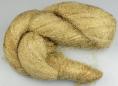
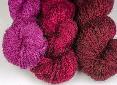
Hemp fibre is usually sold in stricks, which are bunches of long hackled fibres neatly twisted together. It can also be sold in ‘tops’ which consist of shorter lengths of hemp (about 15 cm) which are overlapped to make a continuous ‘top’ and can be spun just like wool.
As the hemp plant is very tall, up to 5 metres, the fibre bundles are long, from 120 to 210 cm long or even longer. Flax fibres, which produce linen, are another bast fibre and, are 45 to 90 cm long, while cotton is very short in comparison, only 2 to 5 cm in length. The long fibre length makes hemp very durable, and gives it great drape allowing designers to create floaty outfits.
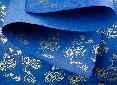
Hemp fabrics are very similar to linen and both have the same interesting texture. Like linen, hemp wrinkles easily adding character to the garment and giving it a carefree look. Hemp fabric is not stretchy and it can feel stiff at first, so it is often blended with cotton to make it softer. However, hemp does become softer with washing and use. Of course, hemp is breathable and biodegradable like all other natural fibres.
Use
Unlike cotton, the whole of the hemp plant can be used; the fibre comes from the stem and the oil from the seeds. In the past hemp fibres were mainly used for making canvas, rope and sails. Now, however, you can find everyday clothes items made of hemp. Hemp can also be used for papermaking and animal bedding. New uses include composite panels for the automotive industry, as well as Hempcrete which is used for construction and insulation. Hemp seeds are used in the food industry, cosmetics and for production of biodiesel.
Cultivation
Hemp is considered an environmentally friendly crop. Hemp farming does not depend on pesticides as diseases rarely affect the yield of a hemp field, and it uses less water than cotton. Because of its height and dense foliage, hemp plants help to control weeds, thus avoiding the use of herbicides. Hemp can be grown in the same field for several years becoming very effective at minimizing the pool of weed seeds in the soil. The hemp crop has several other advantages, in addition to controlling tough weeds, it is also a great rotation crop. Its large root ball loosens the soil, helping to create a good soil structure. It can also help with water and soil purification, clearing impurities from sewage effluents for example. Hemp is an annual flowering herb which matures in 3 to 4 months, much faster than trees grown for paper pulp, as well as producing a greater yield per acre than flax.
History
Hemp (from Old English hænep) has been used since the Neolithic and it is possibly one of the earliest domesticated plants. The oldest archaeological record is of a hemp cord imprint found on pottery in China from the 5th millennium BC. Historically hemp was used to make ropes and sails, including those of Christopher Columbus’s ship. During World War II, hemp was used in uniforms and canvas. It was gradually replaced by tropical fibres, such as cotton and jute, which were cheaper to produce. However, due to the current need for alternative eco-friendly fibres, hemp is experiencing a comeback in fabric for everyday clothes.
Hemp cloth and hemp twine
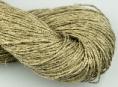
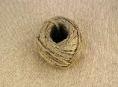
Hemp is used for the manufacture of rope and cord, and for clothing, and nutritional products. Hemp fibre can be used in 100% hemp products, especially for rope and cord, but is commonly blended with fabrics such as linen, cotton or silk, for clothing.
Top of Page